Did Neil Armstrong Leave a Baby Bracelet on the Moon
What's Fact and What's Fiction in First Man
Did Neil Armstrong really exit his daughter's bracelet on the moon? We break it all downwardly.
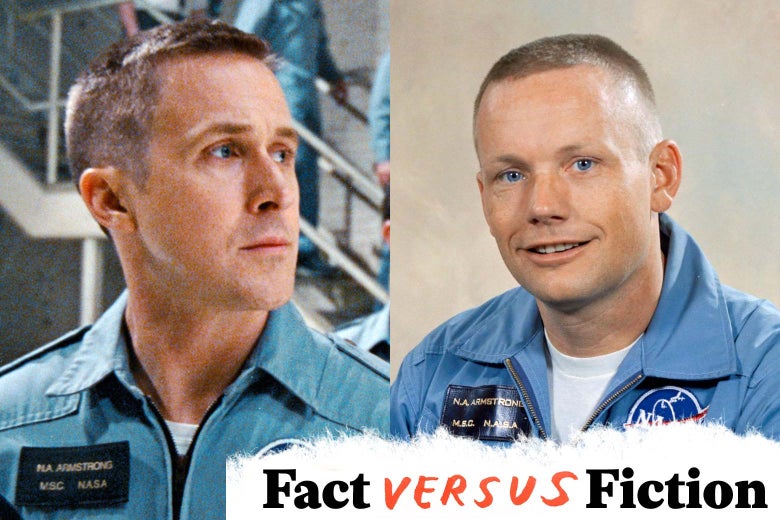
First things commencement: The 1969 moon landing actually did happen, despite the surprisingly long-lived conspiracy theory that the manned missions to the moon were fakes staged in Hollywood. Notwithstanding, the lunatics who believe otherwise are likely to feel bolstered by the meticulously recreated, entirely believable moon landing in Damien Chazelle's First Homo, the story of Neil Armstrong's journey to taking that giant jump for mankind.
Like its hero, First Man, based on James R. Hansen's Armstrong biography of the same name, is understated, emotionally remote, and ambitious. But does it share his dedication to scrupulously accurate information? Below, we break downward what's fact and what's artistic license.
The opening Ten-fifteen flight
The movie starts off with a literal bang as NASA test pilot Armstrong (Ryan Gosling) breaks through the sound barrier in a X-15 "rocket airplane." He takes the airplane to the limits of the Earth'due south upper temper from where he can run into the darkness of infinite. He tries to begin his descent, just its controls do non respond. Keeping his cool instead of turning into a gibbering wreck as some of u.s.a. might, he calculates he can utilise the plane'due south rocket thrusters to assist it autumn back down into the atmosphere, and the program works.
Armstrong was indeed one of the 12 pilots who tested the X-fifteen. In the dense air of the Globe's atmosphere the plane used conventional controls, but in the sparse air above the atmosphere, the pilot was essentially flying in a vacuum, relying on hydrogen peroxide rocket engines to control the hybrid craft. Armstrong fabricated the decision to keep the nose of the plane upwards as he came downward from his top distance in order to test the G-force limiter, which was the purpose of his mission. However, the limiter didn't kick in as he expected, and he was at first unable bring the nose of the airplane downwards and descend. According to Michelle Evans, author of The 10-xv Rocket Aeroplane: Flying the Beginning Wings into Space, the incident was seen as arising from Armstrong's concentrating on his instruments instead of following the process designed by the flight planners. This might accept led to his being dropped from the Ten-fifteen program if he hadn't been accepted by the Gemini program instead.
The death of Armstrong's daughter
The moving-picture show suggests the pivotal emotional incident of Armstrong'south life was the death of his toddler girl, Karen, known in the family unit as "Muffie," who had encephalon cancer. He tried to deal with his fears by keeping detailed notes most her handling during her affliction and and then going right dorsum to piece of work later her death, all the while displaying niggling emotion in public, grieving only when lonely.
Karen Armstrong was indeed diagnosed with an ambitious brain tumor. After radiation treatment proved to be more than Karen could take, the Armstrongs took her home where she died from pneumonia a few months after diagnosis at age two and a half. According to Hansen, the film does not exaggerate the extent of Armstrong's stiff upper lip. "People who knew Armstrong well," he writes, "indicated Neil never once brought up the subject of his girl'south illness and death. In fact, several of his closest working assembly stated they did not know Neil ever had a daughter."
Karen died on Jan. 28, 1962. Armstrong made test flights throughout her illness until Jan. 17, and he was dorsum in the air on Feb. 6, a calendar week later her funeral, taking no fourth dimension off until May. "Neil kind of used work every bit an excuse," Grace Walker, a family unit friend, told Hansen. "He got every bit far away from the emotional thing as he could. I know he hurt terribly over Karen. That was just his way of dealing with it."
Gemini VIII flight

Selected to be the command pilot for the Gemini VIII mission, Armstrong supervises the experimental process of docking the Gemini space capsule with the separately launched Atlas-Agena rocket. The mission seems to be going well as the Gemini completes the complicated docking, just so the Agena goes into a spin, thrashing the capsule with information technology. At the aforementioned time, the coiffure's radio contact with Mission Command goes out. Armstrong makes the decision to decouple, but the detached Gemini capsule starts rolling even faster, tumbling end-over-cease as the crew'south vision starts to mistiness, and it looks similar disaster looms. But as in the 10-15 test flying, Armstrong keeps his cool as he hastily works out some calculations and fires the capsule'southward nose thrusters to stabilize the craft. Back in radio contact, Mission Control tells the astronauts to complete one more orbit and then splash down.
This is pretty much what happened. According to a NASA business relationship of the mission, it was later confirmed that a thruster in the Gemini'due south orbital attitude and maneuvering system (OAMS) had started firing erratically, probably due to a short circuit. Armstrong's quick thinking led him to turn off the OAMS arrangement and instead use the thrusters of the capsule'due south re-entry command organisation to regain command. As a result, for future missions, NASA added a chief switch to Gemini spacecraft that enabled astronauts to turn off individual elements of a organisation not working properly.
Apollo ane fire
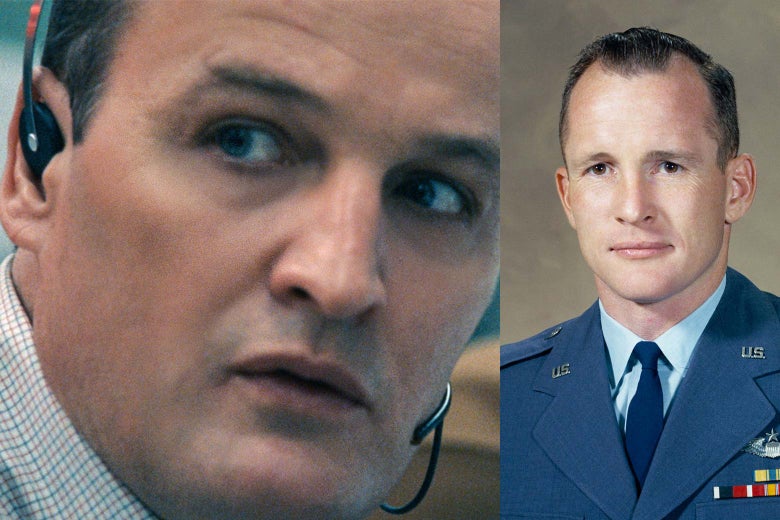
As Armstrong attends a schmoozefest at the White Business firm in January 1967, his fellow astronauts Gus Grissom (Shea Whigham), Roger Chaffee (Cory Michael Smith), and his good friend Ed White (Jason Clarke) strap into the control module of Apollo 1 as part of a launch rehearsal test for the initial mission of the spacecraft that will accept man all the way to the moon.* Confined to their seats and in cumbersome spacesuits, the astronauts are less than pleased to learn that the simulation will be delayed by a couple hours due to problems with the communications arrangement. As the crew makes minor talk and gripe, a small electrical spark ignites a fireball in a thing of seconds while the astronauts frantically but futilely try to open the cockpit door.
This delineation of one of the well-nigh traumatic events in the U.S. space plan's history is accurate. A subsequent investigation found that the cabin's pure oxygen atmosphere meant that even a pocket-sized spark could create an inferno, ane fed past combustible material like cream pads and nylon netting. The pressure level inside the sealed cockpit likewise made the door impossible to open up, especially equally it was designed to open inward. (These blueprint flaws were corrected before the moon mission launches.) Ironically, Grissom had been tagged as the commander for the first moon landing mission, and had he lived, Armstrong would not exist the name history remembers.
In 1971, the crew of Apollo fifteen secretly carried a pocket-sized statue of a fallen astronaut to the moon. They left it at that place as a memorial, along with a plaque begetting the names of the astronauts who had lost their lives in the course of infinite exploration.
Backlash to the Apollo program
In the film, the incident triggers a backlash to the Apollo program, with conservative members of Congress questioning the expenditure of and then much federal money on something so unlikely to succeed, and critics from the left asking why Congress could notice large sums to go to the moon just so piddling to aid people in poverty (such critics are represented past an extended extract from Gil Scott-Heron's proto-rap archetype "Whitey on the Moon").
In fact, while this is true, the space program had much less public support all along than the rose-tinted glasses of nostalgia suggest. According to Roger Launius, NASA's old master historian, "throughout the 1960s a majority of Americans did non believe Apollo was worth the cost, with the ane exception to this a poll taken at the time of the Apollo 11 lunar landing in July 1969. And consistently throughout the decade 45-60 percent of Americans believed that the government was spending too much on infinite."
Neil Armstrong's marriage
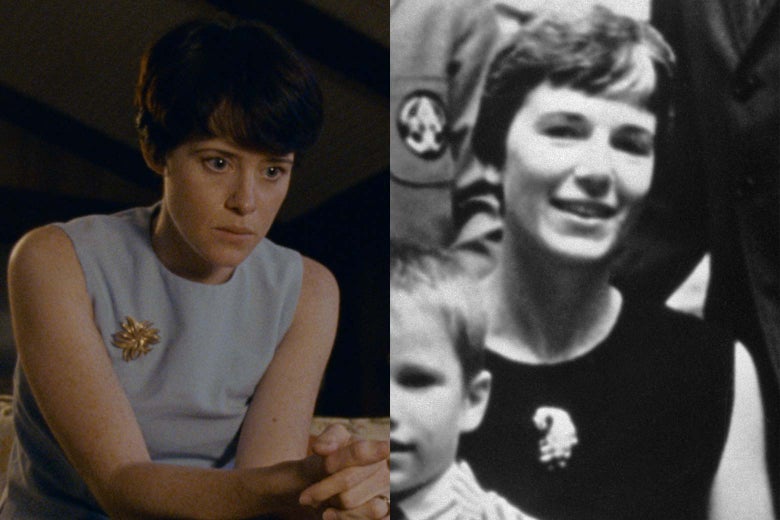
The flick shows Janet Armstrong getting on with raising the family and supporting Neil despite his emotional compartmentalization, keeping his family split from his work and spending far more fourth dimension and energy on the latter. She finally rebels when she asks him to speak to their two boys before he heads off for the moon landing mission to warn them he might not come up back.
This seems to be a adequately authentic representation of the relationship. Janet accepted that as the wife of an astronaut, "our lives were dedicated to a crusade, to try to accomplish the goal of putting a man on the moon by the end of 1969," she told Life magazine in a post-landing interview. At the same time, she did resent Armstrong'due south burial himself in his work to the exclusion of everything else. His leaving then piddling fourth dimension for his family afterward Karen's expiry, Walker told Hansen, made Janet "angry for a very long time." Janet also confirmed that she had asked Neil to speak to the boys earlier the Apollo 11 launch, "but," she told Hansen, "I don't think that went very far." As her son Mark told the Daily Mail, "Janet once said: 'Silence is Neil'due south reply. The word 'no' is an argument.' " The Armstrongs separated in 1990 and divorced in 1994.
Fizz Aldrin
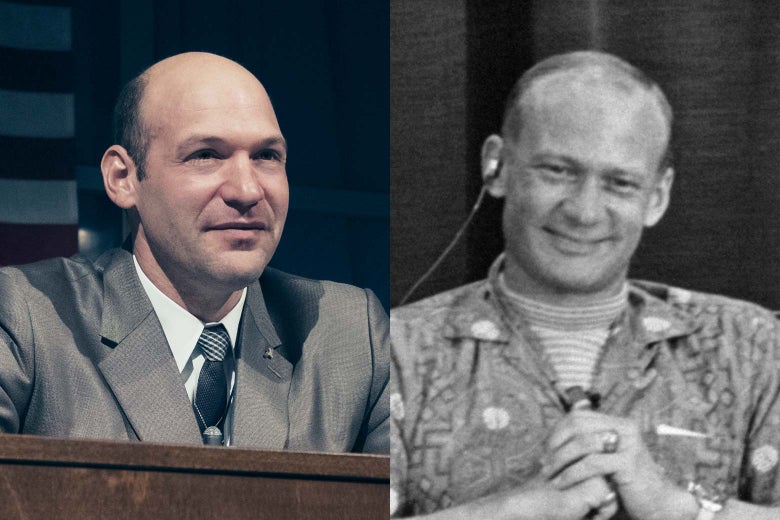
By all accounts, the portrayal of Aldrin (Corey Stoll) equally something of a loudmouth who speaks before he thinks is accurate. Writing in the Infinite Review, an observer of Aldrin's speech to the 2017 Humans to Mars Summit (yes, there is such a matter) reported, "By now, anybody who has been in the space field or attended a few space conferences knows … that he is the space equivalent of Grandpa Simpson: once he starts talking, he won't cease, and he doesn't intendance if nobody is listening, or if he's interrupting the conversation, or if he is inconveniencing others." Even so, even this author couldn't deny that Aldrin is "dauntless" and fifty-fifty a "visionary," noting that he recently became the oldest person ever to accomplish the South Pole.
Apollo eleven moon landing mission
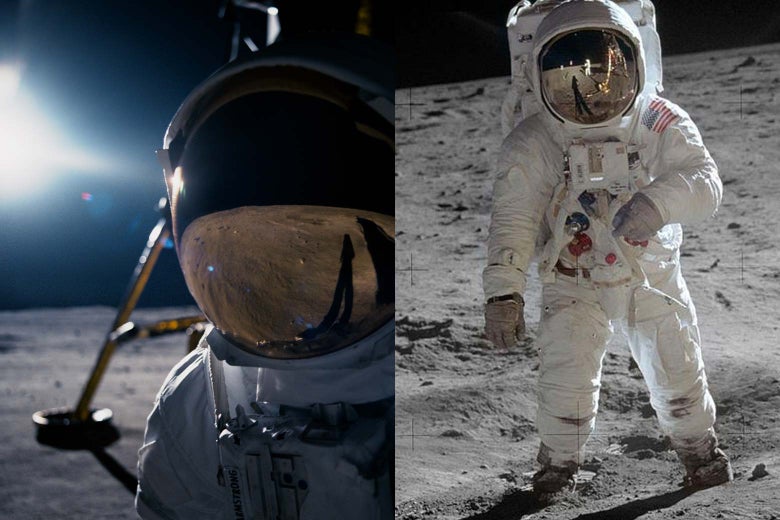
There are 2 major dramatic events in what is otherwise a largely silent, almost dream-like depiction of the climactic mission. One is when an bereft-fuel warning goes off every bit the seconds until a mandatory abort count downwardly. Even so, at that place is nowhere to land—first because of giant boulders on the surface and so because a huge crater looms beneath the craft. With barely two seconds to spare, Apollo eleven clears the canyon and lands on a smooth surface.
This beginning is depicted generally as it actually happened, although in reality there were closer to 20 seconds to spare rather than two. Armstrong and co-airplane pilot Aldrin overshot the predicted landing zone and, flight manually and low on fuel, were faced with a field full of truck-size boulders in contrast to the orbital maps that had indicated a smooth evidently.
The other is the film'due south emotional climax, when Armstrong, having taken Karen's tiny baby bracelet with him on the voyage, releases it into infinite, a sign his lost daughter has always been with him. This, sadly, is pure invention. Hansen writes that the mementos Armstrong took to the moon include some medallions commemorating the Apollo 11 lunar mission, some of his wife's pins, a piece of the Wright Brothers' airplane, and his college fraternity pin, simply that was all, calculation "Armstrong took nothing else for family members—non even for his two boys" or "his daughter Karen."
Still, announcer Jay Barbree's biography of Armstrong does suggest that Karen was in the astronaut'south thoughts. In Barbree'due south account of the moon landing, Armstrong noticed a "baby crater" he named "Muffie's Crater." Equally the book describes it, "He stood at that place, remembering how Muffie would have loved sliding down into the pit. He had an overwhelming urge to practise information technology for her. Only then better judgment grabbed him. He settled for taking pictures and describing what he saw before heading dorsum."
Correction, Jan. ten, 2019: This article originally misstated that the fatal Apollo one test was for "the initial mission of the rocket that volition take manned spacecraft all the fashion to the moon." It was a test of the initial mission of thespacecraft, not the rocket. (The rocket had flown before.)
schreinersteened1981.blogspot.com
Source: https://slate.com/culture/2018/10/first-man-fact-vs-fiction-neil-armstrong-movie-daughter-bracelet.html
0 Response to "Did Neil Armstrong Leave a Baby Bracelet on the Moon"
Publicar un comentario